Author: davidloverme

Product Team Kicks Off!

One of the Tech Club’s three goals is to build the key skills that will make our members successful in the Tech sector.  Since many of our members are interested in Product Management and Start-Ups, we decided to start our own Product Team.  The goal?  Go through the entire product development process from identifying pain points to testing hypotheses to prototyping to launching a product.  Ambitious?  Yes.  Doable?  We think so.  Fun?  Absolutely!

So where are we now?

With a small group of 7 MBAs from backgrounds as diverse as travel, finance, sales, history, and engineering, we have a diversity of talent, opinions, and skills.  We meet weekly and started at the very beginning.  Our first task was to frame our thinking by talking about apps or websites that we like and why.  Among the apps we liked were Opentable and Box and we noted that we liked them because of ease of use and because they allow us to control things like when we pay a bill that we could not control before.  Empowering users though an easy and beautiful user experience emerged as the key to impressing us and a guidepost for us to strive toward.

Listing Pain Points

Our next step was to identify and prioritize pain points in our lives that we could consider addressing.  We came up with 18 different areas and the each chose the five we were most interested in addressing.  Finally we chose all the pain points that received multiple votes and began hypothesizing ways to address them.  The ones we chose to address were Real Time Networking and Company Visibility, Forgetting Accessories, Grocery Price Info, Unsustainable Class Reading Amounts, MBA Shared Calendar, Car Valuations, Funding for Higher Ed, and Network Dead Zones.
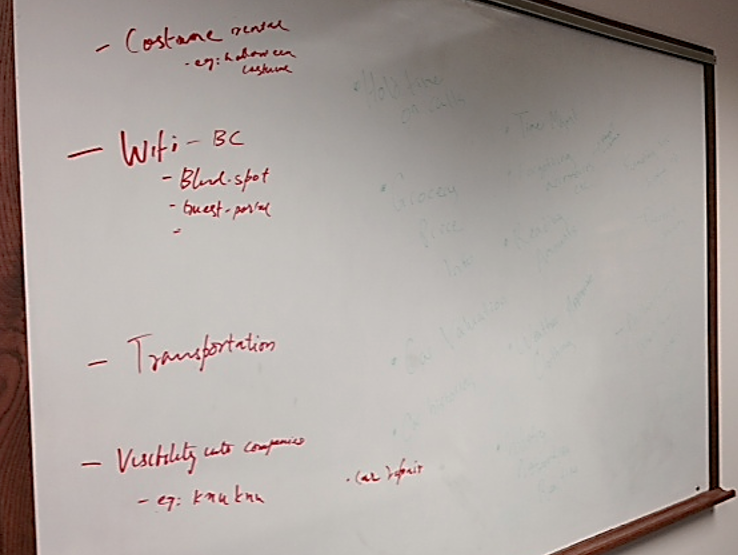
Whiteboard of Pain Points

Whiteboard of Pain Points

Hypothesizing

Our next step was to begin hypothesizing different ways we might be able to address these pain points and brainstorming how we could test them to see which are worth green-lighting to the prototype phase.  To date we have only focused on the Forgetting Accessories pain point and came up with three approaches, each focused on a different dimension of the issues.

  • Reminder app to make sure you don’t leave the house without what you need.  You would specify what you are doing and depending on the response the app would serve up a list of what you should bring.  Future iterations could learn your preferences and adapt recommendations.
  • RFID chips clipped to important items that communicate with phone and let you know in real time if they are separated.
  • A pick-up service that will retrieve your lost items from bars or restaurants the next day and deliver back to you.

Testing the Concepts

As a group, we were most excited about the RFID chips and team members were quick to start browsing for chips.  The keeper of our (very limited) finances, however, I had to lay down the law saying I won’t spend any money until I have evidence that there is a strong desire for the product.  Understanding this, we felt that surveys were the best way to test the market for RFID and the pick-up service.  For the reminder app, we felt that survey’s may not be the best choice but are going to run a FB add to see if people would add emails to a waitlist.

Next Steps

At present, we are still in the hypothesis testing face.  We will address a few other pain points and then use the results of our tests to determine which ideas to pursue further.  Check back in a couple of weeks to see where we stand!

-David LoVerme is a 2nd Year MBA at Boston College and the President of the Grad Tech Club

Grad Tech Summer: David LoVerme

E-Mail: david.loverme@bc.edu
LinkedIn: www.linkedin.com/in/davidloverme
Twitter: @davidloverme

-Where did I work? What does the company do?
I spent the summer at Continuum Managed Services working on the development and launch of an IT Channel specific file sync and share product called Sync247.  Continuum provides white label IT software and support that allows Managed Service Providers and IT Consultants to provide easily scalable and unparalleled value and support to small and medium businesses.

-What was my role?
As the Product Manager MBA Intern, I worked closely with the Product Manager to help facilitate our Alpha, Beta, and Limited Availability programs.  My duties ran the gamut of Product Management and Marketing writing requirements documents, performing competitive research, drafting a pricing and packaging guide, and most importantly communicating with Beta partners to collect, analyze, and operationalize feedback to provide meaningful value.

-How did I find the internship?
I met the product manager at the Boston Product Management Association’s Product Camp conference.  Between tweets and a wall posting we connected to talk about a Product Marketing internship at Continuum.  While that wasn’t the right fit, we made a good connection and Continuum called a few days later asking if I would be willing to interview for a Product Management internship…yes please!

-What are the top 2-3 classes from BC that have been most helpful?
Brand Management with Jerry Smith was tremendously useful.  It gave me a lot of tools and frameworks that I use regularly.  Finance is also key to any product and a strong understanding helped prioritize the what and whens of Product Management.  Data Analysis is key to Product Management and Marketing Research was crucial in developing the tools and skills needed to prove a concept in the market.

-How will my experiences this summer inform my final year?
Having the ability to have such an influential and hands on product management role solidified my decision to pursue the field and helped me laser focus on exactly what sub-sections of Tech would make the right fit.  The culture at Continuum is great and reinforced how big a difference that makes.

-What energizes you about the Tech field?
Tech is full of really smart and ambitious people who push each other to be best they can be.  The idea that nothing is impossible is more than just a saying in Tech, people really believe it and the impossible truly does become possible every day.  The opportunity to be on the cutting edge of innovation is exciting to me and attracts me to the industry.

-What advice would you give to MBA looking to break into Tech and/or your particular space?
Network and talk with as many people as you possibly can.  Ask them to share their story, then shut up and listen!  Not everything people say is revolutionary but the more people you hear from, the better a picture of the industry you can get.  Go to conferences and career fairs, use social media, and apply widely…you never know what is going to be the difference maker.

-David LoVerme is a 2nd Year MBA at Boston College and the President of the Grad Tech Club

Michael Puopolo-HIRED

2b12cdd

Key Stats

  • Grad Year: 2016
  • Concentration: Corporate Finance
  • Undergrad: Lehigh University, ’08 – International Relations
  • Target Role: Strategy or Finance internship, Summer 2015
  • Key Skills: Excel, HTML, SQL, JavaScript, CRM and ATS experience
  • Fun Fact: In high school, I was co-captain of a nationally-ranked Academic Bowl team.

Michael is a first-year MBA student with experience recruiting for the strategy consulting, SaaS, and pharmaceutical industries. Before attending Boston College, Michael graduated from Lehigh University in 2008 with a BA in International Relations and a minor in Economics.  Michael worked for three years on the recruiting team at The Boston Consulting Group, partnering with BCG project leaders to develop and execute successful recruiting strategies at Boston-area business school campuses. Most recently, Michael worked in Talent Acquisition for Bullhorn, a global, equity-backed SaaS-model company. With this exposure to a tech company, Michael enjoyed the intellectual challenges and fast-paced environment that come with a growing company.  In his internship search, Michael is looking for a growing company that will continue to develop his analytical mindset and challenge him to learn new systems and technologies.

Email: Michael.Puopolo@bc.edu

Twitter: @mpuopolo

LinkedIn: www.linkedin.com/in/MPuopolo

Googlers, Analytics, and Google Correlate

Last night Googlers from the Consumer Insights team visited our Analytics and BI Class.  The presentation was fascinating and really made our coursework come alive.  One of the tools we looked as was Google Correlate and as brief assignment for class, I wrote a quick blog post about my experiences playing around with it and thought I would share it here as well:

Our guests from Google’s consumer insights group definitely peaked my interest so I thought I would have some fun looking at different searches I have done today and what correlates based on recent google searches.  While we know and are constantly reminded that correlation does not equal causation, I thought it would be fun to hypothesize some explanations.  Some are legitimate and some just for laughs.  Enjoy and feel free to add your own.

Job Interview

Top Correlations: Analyst, Product Manager

Most interesting: Pass Drug Test

My Take: I had an interview this morning and was trying to make sure I got the most common questions covered.  Looks like I am not alone as “common questions”, “offer letters” and other such queries related to the job search are commonplace.  It also looks like people are very interested in my old job “analyst” and my new job “Product Manager”.  We also see that a number of people having job interviews may also be recreational drug users and concerned about their ability to pass a drug test.  While there are no hard numbers attached, this suggests that a large number of professionals in the US may be users.

Wedding Photographer

Top Correlations: Wedding Flowers, Wedding Planners

Most Interesting: Free Baby

My Take: I was searching because a friend of mine is a highly rated wedding photographer and I was interested to see what his reviews said.  It looks like, not surprisingly, that most people are actually searching for wedding photographers when planning a wedding and therefore also looking for other vendors.  What is less obvious is what exactly a “Free Baby” is and why those seeking Wedding Photographers are curious about them.  I know I promised hypotheses so I will venture one that is completely absurd: Couples who are both planning a wedding and have no candidates for ring-bearers or flower girls are looking to lock them down now but have just seen the cost of wedding photography and other vendors and therefore needed to get the young ones for very free.

Leveraged Buyout

Top Correlation: LBO

Most Interesting: APA Style Guide, Babelfish Translator

My Take: I searched this because of my corporate finance class and LBO makes sense as it is the acronym.  More interesting, however, is APA Style Guide and Babelfish Translator.  Granted they are in the .6 range below Google’s .8 benchmark but correlated nonetheless.  APA Style Guide suggests that the majority of people interested in LBOs are academics studying corporate finance (like myself) and that those actually taking part in them are both few and generally knowledgeable enough to not need to Google it.  I did not know what BabelFish translator was until now but apparently it is the oldest english translation site on the web.  While Yahoo! replaced it with Bing it still exists to redirect and apparently is still used enough to show up in search results frequently.  Not surprising based on the assumption that most people searching LBOs are students is the fact that non-native english speakers studying corporate finance might need frequent translation.

I’ve had some fun with these but even in a generally unguided exploration of Google Correlate we begin to see how it good be used to create hypotheses.  They would need to be tested of course but the the business and academic use cases certainly make sense.

-David LoVerme is a 2nd Year MBA at Boston College and the President of the Grad Tech Club
Talking Shop with Facebook PMs

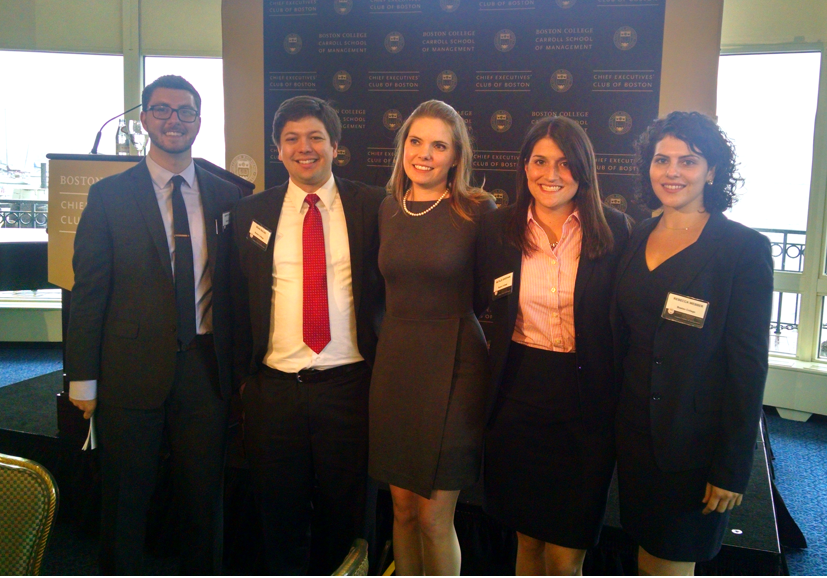
Earlier this week, members of the BC Grad Tech Club had the fantastic opportunity to visit Facebook’s Cambridge office to breakfast with Facebookers involved with the Rotational Product Manager Program.  We learned about the opportunities at Facebook and generally talked shop about what Product Management means at Facebook and how a company with 1.3 billion monthly active users can create a product that can be pushed out globally and still feels incredibly personal and tailored to the individual.  The RPM program is a fantastic opportunity and we are incredibly grateful to Facebookers Ashley Chinn, Greg Marra, and Layla Amjadi for sharing their morning, their insights, and their breakfast with us!

Grad Techers David LoVerme, Nicole Gonzalez, and Marin Rowe in Facebook's Cambridge office

Grad Techers David LoVerme, Nicole Gonzalez, and Marin Rowe in Facebook’s Cambridge office

Even as an experienced product manager myself, I learned a great deal in just a few minutes talking with our friends from Facebook and they were kind enough to allow me to share what I learned here on BCGradTechClub.net.  Over the last year I have talked to hundreds of product managers and gotten a myriad of different answers when I asked what a PM does.  One of the best and most accessible descriptions I have heard came during the breakfast from Facebooker Greg Marra.  “A Product Manager is like a conductor of an orchestra,” he said, even though the conductor doesn’t actually play any of the individual instruments, he or she brings everyone together and coordinates each individual part so that the end result is better than it would be otherwise.  Likewise, a product manager’s job is to synthesize the team so that each individual member can focus on putting their best foot forward.  While some companies have their PM team sit together, at Facebook, each PM is assigned to a Product Team consisting of about 10 engineers, a product designer, an analyst, and a product manager.  Within the team, the PM’s role varies throughout the life cycle of the product but is always related to defining the course and keeping the team on track. At Facebook, product teams follow an iterative cycle of Understand–>Explore–>Execute.  While the team operates as a whole, responsibility for identifying the problem to solve, identifying possible approaches and narrowing in on one, and working with engineering to build it lives with the Product Manager.  Along the way, the PM must plan, set milestones, define goals, and define success.

Interestingly, however, while it really seems like the PM is the leader of the team (after all manager is in the job title!) he or she has no direct reports.  I’ve often heard said, a PM has a lot of influence but no real authority.  Direct reports or not, a PM must deliver and therefore, setting the right vision and rallying everyone to the cause is crucial.  PM’s must be able to adapt their language and mannerisms to their audience, speaking the language of business with executives, technology with engineers, and data with analysts.  Regardless of background, Layla joked, business people are going to think you are tech geeks and engineers are going to think you are business only but if you recognize and accept this and can prove yourself as just a little more savvy than the average bear you will win the respect of everyone and gain the influence you need.  Flexibility, intellectual curiosity, and “strong opinions loosely held” are key to the success in the role.

Grad Tech President David LoVerme at Facebook's Menlo Park headquarters on Grad TechTrek West 2014

Grad Tech President David LoVerme at Facebook’s Menlo Park headquarters on Grad TechTrek West 2014

One of the most eye opening things about our visit was getting a glimpse into the culture of Facebook the company.  With 1.3 Billion users, Facebook is ubiquitous.  Everyone knows the social network and everyone has an opinion.  Lost sometimes, however, is the fact that it is a real company led by incredibly talented and passionate people.  The company’s mission is to give people the power to share and make the world more open and connected.  They have a poster on the wall asking the question “Are we a tech company?” without a definite answer but rather as a means to stimulate real self-examination.  Everything the company does is to fulfill the goal of helping people connect to each other and it is the Product Manager’s role to ensure that every product or feature serves this purpose.  The company seeks people with a curiosity about the world who love to learn, are highly proactive, have a high energy level, and who are positive and yet maintain a healthy dissatisfaction about the status quo.

After spending the morning with Greg, Layla, and Ashley, it is no surprise that Facebook is such a highly sought after and successful company.  Having met them and knowing the other BC Eagles and friends of the Grad Tech Club we have in Cambridge, Austin, and of course Menlo Park the company is ripe with highly talented and passionate people and I am very excited to see what the future holds!

-David LoVerme is a 2nd Year MBA at Boston College and the President of the Grad Tech Club

BPMA Career Night

On Thursday, Sep 18, members of the BC Grad Tech Club attended the Boston Product Management Associations Career Night at the Microsoft NERD Center.  Starting with an hour of networking, we met like-minded MBAs from MIT and Babson and set the groundwork for future collaboration.  Likewise, we spent some time hearing about the great things going on at LogMeIn (where BC MBA Alum Steve Schult runs product for join.me).  After some tasty snacks and fruitful conversations, it was on to the main event: a panel themed on transitioning into Product Management.

There was about and hour of great knowledge but here are a few key take-aways:

  • There is a great demand out there for Product Managers right now but everyone is chasing the same “mythical unicorns” with years of experience, cutting edge knowledge, and strong technical expertise.  Since these are hard to find, companies are willing to hire people making career switches but you absolutely have to demonstrate your translatable skills and communicate them in the language of your target industry.  Highlighting an end-to-end project you have completed and blogging are great ways to do this.
  • 90% of companies use Linkedin at some point in the job process–you cannot be passive and you have to keep your profile up to date
  • Storytelling and Communication are two of the most important skills a PM can possess
  • Find a space you are passionate about and seek it out
    • Take your 2-3 proudest work stories you have and identify what they have in common, this can give some guidance
  • Biggest No-Nos
    • Not knowing the market; who the customer is and what drives the market
    • Showing up on Day 1 and trying to tell people what to do; start by listening and learn as much as you can from other departments
    • Don’t guess, admit what you don’t know
  • Find a mentor (internal or external)
  • Formula for Cold Messaging on LinkedIn:
    • Keep it short but include 4 parts:
      • Statement of Commonality (Same school, shared connection, shared interest, etc)
      • Why them?
      • Call to Action (informational interview, etc)
      • Thanks!

We look forward to future events with the BPMA and to setting up some great on-campus sessions with a couple of the presenters!

-David LoVerme is a 2nd Year MBA at Boston College and the President of the Grad Tech Club

Tech and the Ice Bucket Challenge

Gallaugher Ice Bucket

Grad Tech Advisor John Gallaugher taking the Ice Bucket Challenge

By now you have probably seen dozens of your friends, family, celebrities, and perfect strangers dumping ice over their heads to raise awareness and donations for ALS research.  You might know that Pete Frates, the inspiration behind the #icebucketchallenge to strikeout ALS, is a BC alumnus and captain of the Baseball team while in the Heights.  While it seems like everyone has a different opinion on the matter, the viral trend has raised an unprecedented level of money and awareness for what has really been an underfunded and overlooked disease.  The BC Grad Tech Club supports Pete and his efforts to strikeout ALS and many of our members have completed the challenge, including our President David LoVerme and our Faculty Advisor Professor John Gallaugher.  The movement has certainly taken off because of the genuine efforts and determination of those who started it and the goodness of the cause, but I also want to take a quick look at the Technology that has enabled it.

Social Networking

When Pete Frates entered BC in 2003, Facebook did not exist.  Myspace, Friendster, Livejournal and others were competing for users but none had the sheer user base needed to set off a viral campaign like the one we are seeing now.  BC was the 17th school to get Facebook after its founding in 2004 and it would be a little while more before the Wall would go from an open space editable by anyone to the newsfeed we now see projected to others.

Smart Phones

The first iPhone was released (and marketed by BC’s own Phil Schiller) in 2007.  Prior to that a video going viral meant that for someone to do the ice bucket challenge, they would have needed a video or digital camera, then to tape the challenge, transfer it to a computer, upload it to YouTube (itself only founded in 2005), then share the link.  Such a process creates a significant barrier to entry and would have slowed the growth of the movement.  Smartphones reduce the process to one device and just a few seconds from filming to upload but even these did not reach 50% adoption in the United States until 2012.  Without smart phones, it would be hard to have the ice bucket challenge.

Facebook Video

Video first started to make its way to Facebook in a meaningful way in 2011 but only if you played it.  One of the most enabling features of the Ice Bucket Challenge is scrolling through a feed and seeing your friends in motion dumping buckets over their heads.  This autoplay feature was only released in late 2013 and a strong argument can be made that the ice bucket challenge would not be as successful without it.

Online Payment Services

Sometimes lost in the fun of watching your high school teachers, your girlfriend, and George W. Bush dump ice water over their heads is the fact that it has also raised a ton of money for ALS research…$16 million as of my writing.  That is a lot of money to give to organizations most people had never heard of before.  What makes us so willing to break out the credit cards and input our information online?  This is a testament to the traction that online payment services have gained.  PeteFrates.com allows you donate using PayPal and the ALS Association allows donors to use PayPal or Amazon to complete their donations, often without having to input any credit card information if they already have accounts.  Companies like BC founded WePay are pushing the envelope even further with advances in identity and fraud checks and integration with crowdfunding sites to make fundraising even more accessible in the future.

There are lots of other tech elements that have helped enable the success of the Ice Bucket Challenge such as hashtags and tv online but I think this is enough to give a good taste of the impact Tech can have.  As noted academic Herbert Simon Said, however:

There are no morals about technology at all. Technology expands our ways of thinking about things, expands our ways of doing things. If we’re bad people we use technology for bad purposes and if we’re good people we use it for good purposes.

In my opinion, the Ice Bucket Challenge is a great example of good people using technology for a good purpose.  The BC Grad Tech Club seeks to fortify the Tech industry with Eagles of high moral character and to keep using technology to better mankind.

To learn more about BC Eagle Pete Frates and his fight against ALS, visit: www.PeteFrates.com

To learn more about ALS and what you can do to help, visit: www.alsa.org

-David LoVerme is a 2nd Year MBA at Boston College and the President of the Grad Tech Club

What’s in a domain?

As frequent visitors of our site may have noticed, we are undergoing a major overhaul.  In line with the club’s direction for the 2014 year, we are adapting the site to include things such as the Hire an Eagle page.  The goal was to leverage LinkedIn’s API to embed profile cards directly from LinkedIn.  In fact, it turns out that LinkedIn provides a WordPress plugin that would make the process that much easier.  Despite my best efforts, however, I could not figure out how to add this plugin and ultimately became frustrated.  I had no problem doing this on past WP sites that I work on so what was I missing?

With a bit of research I learned that WordPress is actually two sites, WordPress.COM and WordPress.ORG.  Our site is currently hosted on WordPress.COM which provides hosting and easy tools but also limits the flexibility to customize.  Conversely, WordPress.ORG provides the WordPress site management tools but the site itself is hosted elsewhere.  This allows for much greater customization and the installation of plugins.  In order to install the LinkedIn plugin, therefore, we will need to buy hosting space on another service and migrate the site over.  Thankfully there are are lots of great tutorials online to help us through the process.

A key part of the Tech Club’s mission is to provide our members with meaningful skills based on real, hands-on experience.  Let the learning begin!

For a full comparison of WordPress.com and WordPress.org check out the site.

-David LoVerme is a 2nd Year MBA at Boston College and the President of the Grad Tech Club

BC Grad Tech takes Tech Jam Boston

June 12 was Tech Jam Boston in City Hall Plaza. Some of the best tech companies in the world were on display flanked by food trucks and some pretty talented performers. While I got a free Roxie’s Grilled Cheese and Harpoon Beer (thanks LogMeIn!) the real highlight was making so many great connections with truly friendly and amazing people. No surprises here but BC played a big role! I saw some friendly faces from TechTrek Boston’s Hubspot visit and even ran into double Eagle Steven Schult (BS ’03, MBA ’10) who is now a Sr. Product Manager at join.me, LogMeIn’s stellar screenshare and collaboration tool. We’re looking forward to spending more time with Steven when we visit LogMeIn’s offices later this year! I even ran into the Owl from our neighbors in Newton TripAdvisor. All in all it was a great day despite the weather and something we hope to be an even bigger part of next year. Thanks to all the organizers and to Continuum Managed Services (lots of Eagles there too) for keeping me powered up with all the phone charging stations! See you next year!

-David LoVerme is a 2nd Year MBA at Boston College and the President of the Grad Tech Club