Renato Douek

Renato


Key Stats

  • Concentration: Entrepreneurship and Leadership Management.
  • Grad Year: 2015
  • Previous Employer: Rendimento Bank (Brazil), Marketing Manager; peerTransfer(Boston) International Payments Associate
  • Undergrad: FAAP – Fundação Armando Alvares Penteado (Sao Paulo- Brazil) Advertising/Communications
  • Target Role: Marketing
  • Fun Fact: Renato used his free time to acquire a certificate of the Brazilian Academy of magical arts and also became an expert in hypnosis.

Renato is a Brazilian management leader with expertise in marketing management in the Finance Industry. Skilled in collaborating with members of an organization to achieve business and marketing objectives. Instrumental in streamlining and improving processes, enhancing productivity, and implementing technology solutions. Highly effective team builder and trainer of personnel skilled in leading a team to solve problems and exceed company expectations. Renato also loves technology and is fluent in English and Portuguese.

LinkedIn: http://www.linkedin.com/in/renatodouek

Digital Marketing Experiment 2: Marketing on LinkedIn

Having had some success driving traffic to our site using Facebook Ads, we decided to target LinkedIn for our next experiment.  As a professional social network, LinkedIn has significant information about education, work history, and industry that could help us target BC Alumni in the Technology Space.  Our goal with this campaign, therefore, was to find decision makers in this space, and bring them to the Alumni Central landing page of our site.  From this page, they can learn more about how to help the club including checking out the Hire an Eagle profiles, following us on social media, and even signing up to be a resource.  All in all, we expected that LinkedIn would provide a great opportunity for us to learn a new channel and gain some significant alumni exposure in the process.

linkedin

Initial Experience

In beginning the process, the first thing I noticed was that the flows to set up an ad do not make for a great user experience.  It was not immediately apparent to me how to get started, and when I did get on the right track I ran into issues uploading images and making edits that required backtracking.  Despite this, however, I eventually got the ad set up how I wanted it proclaiming “Help out an MBA at BC!” and directing them to our Alumni Central page to find out how.  Once the content was written, I moved on to setting up the parameters.  LinkedIn requires you to set a minimum budget of $10 per day.  The lowest I could set my max bid for impressions was $5.73 should anyone click the ad.  This was not particularly well explained, so it took some time to figure out the settings.  With a total budget of just $50, I was worried that we would exhaust our funds very quicky and with only a few folks clicking through to our site.  While some clicks were better than none, my expectations were that we would only get a few visits to our site and even fewer responses to our contact form.

The Ad in Action

As it turns out, my fears about burning through our whole budget immediately were misplaced.  Despite a target audience of more than 6000 individuals, we only got 3 impressions over the course of a month, none of which resulted in any clicks.  As a result, the campaign was costless for us, but it was also resultsless.

li2

Adjusting

My first indication that something was wrong came in email form from LinkedIn, where the Ads Optimization email showed a whole lot of zeroes.  Despite the name of the email, however, the only guidance given was a suggestion to widen the audience.  This begged the questions of how much and who to include?  Widening the audience would mean making tradeoffs regarding target industries or the level of decision-making power.  At the end of the day, the tradeoffs simply didn’t seem worth it and the user experience was not pleasant enough to continue.  Instead, I shifted my strategy to personally post in a number of BC related alumni groups.  Theoretically, the exposure would be less as alumni would only see the post when in the group as opposed to it appearing whenever they browsed, but in practice, BC’s active alumni presence actually led to wider exposure, and organic visits to our site.  Four alums even signed up to help out the club.

Key Takeaways

While we had high hopes for LinkedIn ads, it turns out they were not a great choice for our purposes.  With a small budget, and less experience in the realm of social marketing, the constraints and user experience made it difficult for us to launch a useful campaign.  Likewise, the reporting and optimization insights are far from prescriptive.  Overall, it seems that LinkedIn advertising might be useful for companies with experienced digital marketers and high budgets, but that smaller bootstrapped organizations such as our own are better off using the organic channels that LinkedIn provides such as groups and stories.

Up Next: Targeted Tweets!

David LoVerme is a 2nd Year MBA at Boston College and the President of the Grad Tech Club

Some Initial Thoughts on Landing a Job at a Startup

Our own Bobby Gooch shares his thoughts on landing a job at a startup!

bgooch3's avatarUnstructured Data

Trying to get work at a startup has become a popular goal for a lot of people in today’s job market. And for good reason: small technology companies tend to attract smart, motivated people and allow you to do work that can actually have a pretty significant impact on the business. But how do you go about getting a job at a company like this, especially with little to no background in coding? While there is no definitive, step-by-step process, I hope my experiences can give you a bit of an idea of how you may want to go about trying to get a job at a startup. I’m planning to do a couple of posts on this; here’s number one:

First, a little background on me: I spent 3 years working at a fin-tech company where I learned the basics of SQL. I’m now finishing up business school while…

View original post 486 more words

2014 Annual Report

Dear Grad Techers, Alumni, Friends, and Supporters:

It is with pride that I look back at the past semester for the Grad Tech Club.  In less than four months, we have accomplished a ton, always toward furthering our mission of equipping our members with the knowledge and skills necessary for success in the tech industry, raising the overall profile of the BC MBA program within Tech, and getting our members hired!

Toward the first goal of building hands on skills we have had several initiatives.  Each Friday, MBAs led by GradTech VP Kori Kenerson, plug away at CodeAcademy’s Python course for Code & Coffee.  Likewise, on Thursday evenings, the Product Team gets together to ideate, test, and release a real tech product.  We are currently in the proof of concept phase with a few very interesting ideas.  You can check out our progress here and here.  Finally, each month we take on a new Digital Marketing Channel to explore its options.  So far we have tried Facebook and Linkedin and we are currently exploring promoted tweets on Twitter.  In addition to these, GradTech members are gaining html and web development skills from using WordPress and A/B marketing skills from experimenting with Mailchimp.  We will continue these initiatives as we move forward so that BC MBAs won’t just graduate having done case analyses with hypothetical solutions but will also have applied the skills we learn to real tools and real products in the Technology space.

Our biggest initiative to raise the profile of the MBA program in Tech has been our website and social programs.  We do lots of cool things and then we blog, Facebook, and Tweet about them. From a previous best year of just over 200 visitors, we now get hundreds per month and we hope to break 1000 MAUs in 2015. Among our members we enjoy a sky high Net Promoter Score of 75 and we have had alumni express interest in getting involved, companies reach out to partner with us, and prospect students cite our club as one of the main reasons they are interested in BC for an MBA.  All of these are indications that we are pushing forward but the biggest differences will come from placing our people in meaningful Tech jobs and helping out future Eagles.

To that goal, we continue to push forward.  We have attended job fairs and industry events put on by Microsoft, the Boston Product Management Association, and even sponsored the Startup Job Fair.  We have visited the Cambridge offices or Microsoft and Facebook by ourselves and many more including Spotify and Paypal in conjunction with the Undergrad IS Academy through the TechTrek Boston program.  Furthermore, on campus we hosted Alum Arnie Sookram from XBox and four MBA Alumni from Google, LogMeIn, Hubspot, and Wayfair to talk about the different careers and cultures within the Tech space.  Well attended and highly praised, the Careers in Tech Panel has already led to a number of connections and we hope to hold a similar event featuring even more functional areas in the spring.  Finally, we continue to drive alumni to help our cause through our Alumni Central and Hire an Eagle Page.  We already know of some jobs coming out of these initiatives and we hope for many more.

As we move into the spring we will continue to move forward towards the three pillars of our mission.  Off campus we will visit as many industry events, offices, and career fairs as we can, and on campus we will host another Careers in Tech Panel, an event on What Every Manager Needs to Know About IT, a discussion on Women in Tech, and a Digital Marketing Dinner.  We will continue to develop our product and hope to host a rousing Launch Party in April.

I thank you for all your support thus far and look forward to a fantastic 2015!

Sincerely,

David LoVerme

President, BC Grad Tech Club

David LoVerme is a 2nd Year MBA at Boston College and the President of the Grad Tech Club

Better late than never: the first BC Tech Club Ad Experiment Results

So we completed our first BC Tech Club online ad campaign last month. It’s a bit late, but I’d like to share with you the results of our little experiment.  As I detailed in my blog post of one month ago (link) we dipped our collective techy toe in to the digital waters with a series of Facebook ads with a goal of driving traffic to the Hire An Eagle page of the BC Tech Club website. To recap, below are the three ads we ran from October 8th, to November 8th. In total, between all three ads, we received 50 click-throughs to the Hire An Eagle page, and generated 2,144 impressions, as well as a paltry 9 likes to the BC Grad Club FB page as a result of seeing the ad. In other words, while only a handful of people may have visited the website, 2,144 unique pairs of eyeballs saw one of the three ads. Facebook counts impressions not just from our target audience segment, but also from target audience members’ extended web of connections. So when someone in our target segment likes our ad, that like makes the ad visible to all of that person’s friend via the news feed, dependant of course on varying news feed settings.

We thought it would be fun to experiment with Facebook’s A/B testing feature by offering all three ads with the same copy, same target audiences, and testing three different ad images. It was our postulation that the ad with the photo of Gasson Hall would be the most successful of the three. Since we were targeting specifically Boston College alums, it stands to reason that (hopefully) positive memories and associations of would draw them like a magnet to click on that picture.

Alaina1

We discovered however, that we’re terrible at prediction.

The most popular ad by far was the group photo ad, with 22 clicks and 1,734 impressions. It’s impossible to say for sure why this picture piqued the most interest among our target. My best guess is that the photo shows individuals clearly working in a business setting which best matches the subject matter of the ad. The Gasson photo on the other hand, while it might make alumni swell with Eagle pride, does not in any way reference recruitment or business. So the Gasson photo might not stand out amongst the other BC-related FB ads that our alumni audience is probably seeing.

And Now Onto January…

And with these lessons being learned, we’re ready to launch another Digital Marketing Experiment. For the month of January we are going to turn our ordinary ol’ BC Tech Club Twitter account into a PROMOTED Twitter account! The way it works is simple, we set the parameters for the segment of Twitter users that we want to target. These individuals then will see “BC Grad Tech Club” appear under the “Who To Follow” section on their homepage, and our account will show up higher in related searches. The targeting options for promoted accounts are relatively limited, presumably to ensure clients maintain a broad reach. We can segment by targeting twitter-users similar to a specific account’s followers, for example we might want users similar to those who follow @TechCrunch. We can also segment by interest category, and within the Technology & Computing category there are plenty of interests to choose from. And that’s basically it. It’s a very straightforward service to use, and clients are only charged per new follower so we are paying explicitly for desired outcomes, rather than for less meaningful interactions.

Alaina4

The goal here is audience building; we want to enhance discovery of the BC Grad Tech club among those individuals who would be interested in learning about our activities at Boston College, and who might want to hear what we have to say. We want to increase overall engagement with our Twitter account and increase our followers. Every new twitter follower is a new touchpoint for the BC Grad Tech Club, and a new potential networking contact for all our members.

– Alaina Tucker is a 2nd Year MBA at Boston College and the VP of Marketing for the Grad Tech Club

Catching up with the Product Team: Failing Forward

One of the Tech Club’s three goals is to build the key skills that will make our members successful in the Tech sector.  Since many of our members are interested in Product Management and Start-Ups, we decided to start our own Product Team.  The goal?  Go through the entire product development process from identifying pain points to testing hypotheses to prototyping to launching a product.  In our last update, we had arrived at five different hypotheses to address two different pain points.  Since we don’t have the resources to build all of them, we needed to figure out how to test the concepts for user acceptance early on in the game.

The First Concept

Our first concept was a service you could check before leaving the house that would remind you of what you needed to bring with you.  It would adapt to your preferences and to current trends.  This would address the pain points of being unprepared as well as forgetting things when you come home since you could cross-reference the list to see what you brought before leaving your location.  We felt very good about the value and confident that people would be interested but wanted to make sure.

Defining Success

While we were confident that people would see value in a product like this, it would not be enough for them to be interested, we would need them to demonstrate a willingness to take meaningful action.  Ultimately, we determined that users could demonstrate this by adding their emails to the Beta list so they could be the first to try the app when it was ready.  If we could get even a few people to give their emails, we determined, that would be enough of a token of interest to be worth pursuing a minimum viable product.

Testing the Concept

In order to collect email addresses, we built a simple landing page on our website explaining that “ForgetMeNot” is an app currently under development that reminds you of what you need and learns your preferences so you never leave the house unprepared.  It contained an embedded Google form to collect emails.  While we have seen a substantial increase in web traffic, it would not provide enough organic traffic to give us a good indication of interest.  As a result, we ran a $25 Facebook ad campaign to drive young urbanites to our page.  The ad would run for five days.

ForgetMeNot

Interpreting the Results

After a little over 5000 impressions we had a click through rate of 0.55%, representing a cost per click of $0.86.  While this is not up to par for agency ads, the CTR is actually above the average for external site ads, but the CPC is more costly.  Still however, taken alone, these results seemed to suggest that ForgetMeNot had similar appeal to existing and successful applications currently on the market.  There was one more step though, would people take action by adding themselves to the Beta list?  Of the 29 people who clicked our ad, only one took this action.  That represents just 3.5% of our clicks and a miserly .02% of impressions.  Viewed in this light, the foundation for pursuing this idea further simply does not exist.

Failing Forward

While the results were disappointing to a degree, they are also extremely exciting.  For $25 and no development, we were able to get a good handle on user demand and pivot to the next idea without wasting time or money.  With 4 more ideas left to test, we will continue to move fast and fail forward!


David LoVerme is a 2nd Year MBA at Boston College and the President of the Grad Tech Club


Cyberposium and Why an MBA Matters

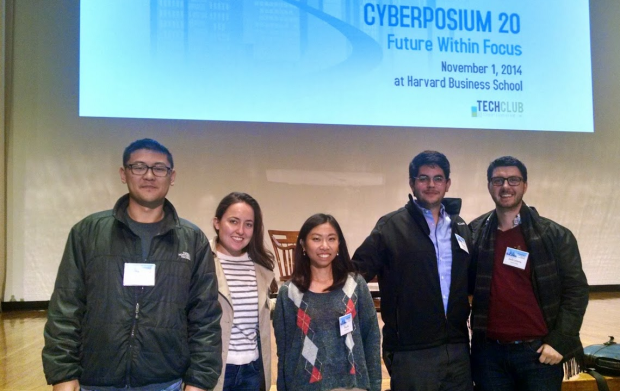
Earlier this month, several members of the BC Grad Tech Club attended the 20th Annual Cyberposium, presented by our friends at the HBS Tech Club.  As we have come to expect, the event featured solid speakers and was very well run.  A huge thank you to the HBS Tech Club for a job well done.

For me, the highlight of the event came early in the day during the first keynote which was a tag team effort  by Jenny Fleiss of Rent the Runway and Scott Friend of Bain Capital Ventures.  Many of us visited RTR’s NYC offices last spring as part of TechTrek NYC and I was impressed by how much growth the company has seen in such a short amount of time.  This particular presentation was eye opening because Scott was the VC who met with and funded Jenny and RTR and therefore we had the unique opportunity to hear the story of the company from both the Founder and Investor perspectives.  Among the key take-aways were the concepts of “do it first, scale it second” and using B-School profs as advisors, after all they have to listen to us!  From the VC perspective, Scott said that one of the first things that impressed him was that Jenny and her co-founder stood up when presenting and had already done the legwork to prove the concept.  I note this because good presentation skills and due diligence are key attributes we develop and polish as MBAs.

The marquee keynote for the day was Y-Combinator President Sam Altman.  I am one of the many folks out there following his “How to Start a Startup” course via YouTube so it was particularly neat to see him speak in person.  One of the things Sam noted was that in many ways you actually have to untrain yourself.  He was a particularly interesting speaker because he gives the impression, sometime quite straightforwardly, that he does not think particularly highly of business school and MBAs.  When asked where MBAs can add value to a startup, he suggested once they really hit the acceleration point on the growth curve and need to scale quickly.  Other key take-aways: “If you don’t have an idea, don’t start a company,” and “Startups commit suicide far more often than they are killed.”

sam

While I really enjoyed the event on the whole there were a couple of recurring themes with which I took issue.  To some degree, despite the location there was some advancement of the idea that B-School is a bad investment or toxic to starting a startup.  Obviously, as an MBA myself I have a biased perspective but I firmly believe that an MBA can be an extremely powerful asset, if for no other reason than it requires you to think about a number of different businesses and to go through some serious self-examination for at least two years.  If taken advantage of properly, this can give the time needed to identify an issue, a suffering population, and some hypotheses to address it.  Indeed, a little digging reveals that a full third of Unicorns (Billion dollar companies founded in the last 10 years) have at least on MBA founder, and more than half have an MBA executive.  (http://bostonvcblog.typepad.com/vc/2013/11/unicorns-and-mbas.html)

Another (perhaps more prevalent) theme was that an MBA is only worth it if you go to one of the top 5-10 schools.  Certainly these are over-represented in executive positions, etc. but as I approach the end of my two-year B-School journey I can honestly say that the experiences, skills, and time for reflection has made me a much more effective professional and I would not trade it.  I am working on two different products at the moment (read about one here) and have chatted with CEOs at the likes of Etsy, WePay, ThredUp, Rethink Robotics, and IBM, and other executives at companies like Apple and VMWare.  Furthermore, I am a firm believer that education in all its forms is generally a good thing and an a strong appetite for learning is a key tenet for success.  I found a kindred spirit at the conference in Jeff Engler, cofounder of Podimetrics.  His positive energy and passionate defense of the value of MBAs, Accelerators, and any opportunity to work hard alongside other driven people was inspiring.  (Not surprisingly he is a fellow Columbia History Undergrad-long live the liberal arts!)

All in all, I thought the event was great and very insightful.  While we at BC tend to be more collaborative and less cutthroat than some other business programs, we certainly are determined and can be competitive.  At the Tech Club in particular, we love bucking conventional wisdom and I am excited for the great startups that will continue to come out of Fulton and combat these notions.

Other Key Take-Aways

  • Customer Success is very different than customer satisfaction. Cant be successful without it.
  • If you’re not having fun in business school, you’re blowing it. -Mark Wallach
  • Keep a keepers list of the best ppl you work with then use that to hire when you start a company. -Sam Clemens

-David LoVerme is a 2nd Year MBA at Boston College and the President of the Grad Tech Club

Code and Coffee

As part of the Tech Club’s goal of creating opportunities for students to further develop their “hard skills” through practical learning experiences, we’ve recently been hosting weekly Code & Coffee sessions. We had our first meeting two weeks ago, and it was a great success as we crushed code and rocked out to “Don’t Stop Believing” Pandora radio.

These meetings are primarily designed to promote a collaborative learning experience for those trying to learn programming. Instead of individuals tackling it on their own, the idea is to create an environment where students can seek help from each other as they move through the same curriculum.

The sessions are essentially structured as a self-directed study group that meets on a weekly basis to go through a set curriculum together. The curriculum we’ve been following is the Python tutorial on Codecademy. Python is a great introductory coding language due to its heavy emphasis on readability. It also appears to be the language of choice among data scientists. The Codecademy platform is highly interactive and especially intuitive / user-friendly for beginner programmers. The entire tutorial only takes about 13 hours to complete, and we’ve already made solid progress during our last two sessions.

Grad Techers getting their code and coffee on!

Grad Techers getting their code and coffee on!

Setting aside a weekly meeting time is also intended to maintain a higher level of discipline when it comes developing these hard skills. From my own personal experience of attempting to teach myself programming through an online course, I’ve struggled to keep up with it. Something more important or pressing always seems to come up—it’s so easy to push off going through that next online lecture or exercise without a set schedule. We’re hoping that working alongside others in a collaborative group setting that meets regularly should make it easier (and hopefully more enjoyable!) to keep up with the material.

Once a group of us is able to develop a decent comfort level with Python, the longer term goal of these sessions is to work on a Kaggle project together to really put our skills to the test. Kaggle is a platform for predictive modeling and analytics competitions on which companies and researchers post their data and then data miners/statisticians compete to produce the best model (essentially the data science version of TopCoder). Tackling one of these real-life projects would provide a great opportunity to practically apply the skills we develop.

We’re hoping that interested students will take advantage of the opportunity to develop their technical “hard skills” to supplement the conceptual material and softer skills of BC’s MBA program. Join us on Friday afternoons at 2:30pm—if not for the coding, then at least for the free coffee, good music and good company! What better way to spend a Friday afternoon?

Also all levels of programming experience are welcome! In fact, advanced programmers are particularly encouraged to attend. If you have any other projects you’re working on using languages other than Python, please don’t feel restricted at all – this group is truly designed to learn and collaborate as much as possible.

If you have any suggestions for our group, please don’t hesitate to let me know. These sessions are definitely a work-in-progress! Email kenersko@bc.edu for any questions, suggestions, etc.

Kori Kenerson is a 2nd Year MBA and VP of Analytics for the Grad Tech Club

ALUM ARNOLD SOOKRAM FROM XBOX VISITS THE HEIGHTS

Last week, I had the pleasure of hosting BC alum Arnold Sookram on behalf of the Graduate Tech Club and Undergraduate Career Services. Arnold is a Senior Business Manager of Free-to-Play Digital Games at Xbox and spoke to a group of undergraduates and MBA students interested in gaming and technology. I interviewed Arnold and we discussed the breadth and depth of his impressive career in wireless and digital media. We were all really fortunate that Arnold came to share his career insights with us.

Arnold told us that gaming has exploded into a $70 billion industry across all platforms. We discussed the competitive landscape and how Xbox fans are embracing the digital-download revolution. Arnold walked us through his regular interactions with content producers, and how he attempts to maximize the impact of the release of each game add-on. For those who aren’t familiar with the model, free-to-play games are made available at no cost and generate revenue through add-on content that is made available for purchase.

Arnold also spoke to how Microsoft has been transforming for the mobile-first, cloud-first world under the new CEO, Satya Nadella. He reminded us that Nadella’s first major acquisition as CEO was Minecraft creator Mojang, a sign of Microsoft’s continued commitment to great gaming content.

arnie

When the audience Q&A session that followed the interview began, students had a lot of questions for Arnold. It was clear that the everyone present were very knowledgeable about the industry and eager to learn more, continuing to prove that #BCisTech.

On behalf of the Grad Tech Club, I would like to thank Arnold Sookram once again for engaging with us last week! It is great to have such loyal Eagles in our alumni network who are so excited to speak with current students. I am looking forward to visiting Arnold and the Xbox team in WA this January with the Graduate Tech Trek West field study program and potentially hosting him again in the Spring.  If you’re interested in hearing Arnold speak the next time he is on campus, sign up to be notified here.

John Dentinger is a first year MBA and member of the Grad Tech Club at Boston College.

John Dentinger-HIRED

John
Key Stats:
 
  • Concentration: Marketing Analytics, Product & Brand Management
  • Grad Year: 2016
  • Previous Employer: Harvard Business Publishing, Marketing
  • Undergrad: Emerson College 2014
  • Target Role: Marketing Internship in Tech, Summer 2015
  • Fun Fact: John graduated from Emerson in three years, while studying Leadership & Management and majoring in Media Studies.
John is a first year MBA candidate with a strong passion for Media and Technology. He aspires to develop innovative, data-driven marketing campaigns that educate consumers on the latest technological advancements available to them. John’s desires to become an industry thought-leader and to build his marketing and management skills led him to the Carroll School of Management this year. He is excited to be participating in the Grad Tech Trek West field study program this January. He is looking to transition into the Tech industry post-MBA.
Prior to BC, John worked for Harvard Business Publishing. He was hired as the Marketing and Publicity Assistant for the Harvard Business Review Press after completing a successful Sales and Marketing internship. As a undergraduate, John served as his student government’s Executive Treasurer and managed $500,000 in student activity funds. He wrote his Senior Honors Thesis on the Marvel Cinematic Universe and was awarded the Outstanding Senior Award for Media Studies.